


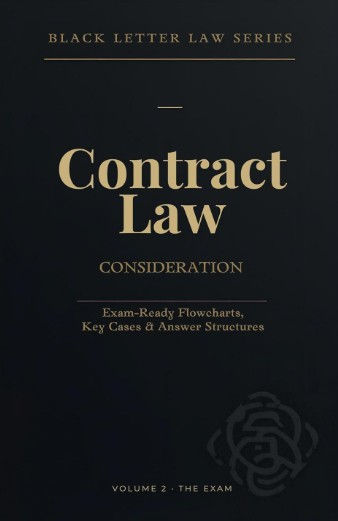
Contract Law - Consideration Explained
Contract Law: Consideration Explained
Black Letter Law Series
A promise alone is not enough to create an enforceable contract. The doctrine of consideration determines which promises the law will recognise and enforce, making it one of the most frequently examined topics in UK contract law.
This concise visual guide explains the principles of consideration through clear legal rules, leading authorities, practical flowcharts and examiner-focused answer frameworks. Designed specifically for LLB students, it provides a structured approach to analysing consideration in both problem questions and essays.
Inside this guide you will learn:
- What consideration is and why it is essential to contract formation
- The difference between sufficiency and adequacy of consideration
- Why past consideration is generally invalid and its recognised exceptions
- When performance of an existing public or contractual duty amounts to valid consideration
- The modern doctrine of practical benefit following Williams v Roffey Bros
- The rules governing part payment of debts and their exceptions
- The relationship between consideration and promissory estoppel
- How to apply the leading UK authorities in examination scenarios
- Step-by-step visual flowcharts for analysing consideration
- Examiner-style answer structures, revision summaries and common exam pitfalls
Featuring concise explanations of landmark cases including Tweddle v Atkinson, Thomas v Thomas, White v Bluett, Re McArdle, Lampleigh v Braithwait, Stilk v Myrick, Williams v Roffey Bros, Foakes v Beer, Pinnel's Case, and High Trees, this guide equips students with the doctrinal knowledge and analytical framework required to answer contract law questions with confidence.
Ideal for:
- UK LLB students
- GDL/PGDL students
- SQE candidates
- Law revision and examination preparation
Part of the Black Letter Law Series, a collection of concise, visual, exam-focused guides designed to simplify complex legal principles and improve exam performance.